
Leaving hospital should feel like good news. For many people living with disability, though, it is also one of the riskiest moments in their care. The ward team that knew their medications, routines and warning signs is no longer in the room, and the family, support workers and community providers taking over may be working from a short discharge summary.
Good hospital discharge planning closes that gap. This guide explains how discharge planning works for NDIS participants in Adelaide, who is responsible for what, and how nursing support makes the transition home safer in the first days and weeks.
Quick answer: Hospital discharge planning is the process of preparing someone to leave hospital with the right care, equipment, medication and support already in place at home. For NDIS participants, nursing support helps turn the discharge plan into daily practice by managing health-related needs, coordinating with the hospital and support team, and spotting problems early.
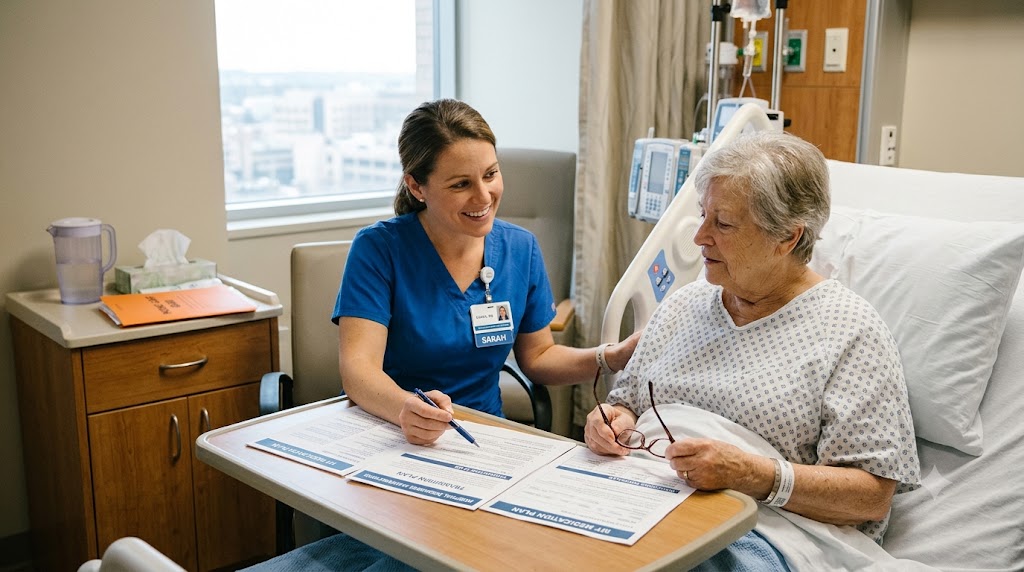
What is hospital discharge planning?
Hospital discharge planning is the process hospitals use to prepare a patient to leave safely. It covers follow-up appointments, medication changes, equipment, personal care, transport, and who to call if something changes.
For NDIS participants there is an extra layer. A hospital stay can change a person’s disability-related support needs, so the NDIS plan, support coordinator and providers all need to be part of the conversation. The NDIA notes that some participants need a short- to medium-term interim plan to leave hospital safely, and that these plans still have to meet the NDIS funding criteria.
A discharge date matters, but a plan built only around the date is a risk. The real test is whether the person is safe, supported and understood on their first night home.
Why the first days at home carry the most risk
In hospital, monitoring is constant. At home, that responsibility shifts to the person, their family and their support team. Handover gaps tend to appear in the same places:
- New or changed medications that are not collected, understood or given on schedule
- Equipment such as shower chairs, pressure-relieving mattresses or hoists that has not yet been delivered
- Wound, continence or feeding instructions given verbally and then forgotten
- Support workers who do not know what has changed
- Follow-up appointments that are not booked, or transport that is not arranged
- No clear person to call when something feels wrong
These are rarely failures of care. They are failures of handover, and handover is exactly where nursing support is most useful.
How NDIS hospital discharge works
The NDIA publishes an indicative hospital discharge process. In broad terms, it looks like this:
- Identify and notify. Hospital staff identify the patient as an NDIS participant and, with consent, notify the NDIA. If the person is not yet a participant but may have a permanent and significant disability, staff can help lodge an access request, which the NDIA says it aims to complete within 7 to 10 days of being notified.
- Make contact. The NDIA states that its hospital discharge team contacts the participant, or their representative, within four days of being notified of an admission. An NDIA health liaison officer (HLO) also contacts hospital staff within that time.
- Share health information. The hospital provides information about what the person will need on discharge. The NDIA offers an optional Discharge Assessment template to keep this consistent.
- Plan. The NDIA may arrange a home and living assessment, holds a planning meeting, then approves and implements an updated plan.
- Set up and follow up. A support coordinator works with the participant, hospital and providers to arrange supports, attends a discharge planning meeting if required, and checks in afterwards to make sure the person is stable and settled.
Timeframes are targets, and real-world timing varies with complexity, housing and how quickly information arrives. That is why starting early matters. You can read the full process on the NDIS hospital discharge page.
Who is on the discharge team?
| Who | What they do |
| Hospital discharge planner or social worker | Coordinates the hospital side: medical readiness, referrals and timing |
| NDIA health liaison officer | Links the hospital and the NDIA so planning information moves quickly |
| Support coordinator | Connects the participant with providers and coordinates the transition (see what an NDIS support coordinator does) |
| Community nurse | Provides health-related support at home and liaises with the GP and hospital team |
| Allied health (OT, physiotherapy) | Assess equipment, home set-up and mobility |
| Participant, family and carers | Know the person best and make the decisions |
How nursing support makes discharge safer
Registered nurses bring clinical judgement to the parts of discharge that support workers and families should not have to manage alone. Community nursing care is delivered in the person’s home, which means the nurse sees the real environment, routines and risks, not just the discharge paperwork. For a broader overview, see our guide to community nursing care under the NDIS.
Turning instructions into a routine
A discharge summary is a document. A routine is what keeps someone well. A nurse can read the summary with the family, clarify anything unclear with the GP or hospital, and help set up a day-to-day plan covering medication times, positioning, skin checks, fluids and rest.
Supporting medication safely
Medication changes at discharge are common. A nurse can check that supplies are on hand, that what is being given matches the discharge summary, and that missed doses or side effects are reported. Decisions about changing medication stay with the prescriber, so the nurse’s role is to notice, record and escalate rather than guess.
Providing clinical care at home, where appropriate
Depending on assessed needs, funding and scope of practice, home nursing may include wound care, continence care, enteral feeding support or health observations. Our article on in-home nursing vs hospital care explains where the line sits between the two.
Spotting problems early
Because nurses know what recovery should look like, they can recognise changes such as increased pain, new redness or swelling, reduced appetite or unusual drowsiness. They can then decide whether to contact the GP, call the hospital or seek emergency help. Acting early gives a small problem a better chance of being managed at home.
Briefing the wider team
A nurse can explain to support workers and family what to watch for and when to call, so everyone works from the same plan. This pairs naturally with day-to-day help such as assistance with personal activities.
Building continuity and confidence
Seeing a familiar, trusted face lowers anxiety for the person and their family during a stressful week. We explain why in why consistency matters in NDIS support.
What the NDIS will and will not fund
Funding is where families are most often surprised, so it helps to be clear.
- In hospital: the NDIS does not typically fund support workers or clinical care while a person is an inpatient, because the hospital is responsible for their care. It may fund planning for post-discharge supports and training for hospital staff in a participant’s specific needs.
- After a recent illness or injury: the NDIS does not typically fund community nursing to treat a recent medical event, because the health system is responsible for that care. It may fund disability-related support, for example a support worker where a person’s disability prevents them from managing their own wound care safely.
- Other options: private funding is available for nursing needs that fall outside the NDIS.
What is funded depends on the individual plan and the NDIS funding criteria. Check with your support coordinator or the NDIA before booking support, and read the NDIS guidelines on services if you are in hospital. If you are unsure how coordination and plan management differ, see support coordination vs plan management.
Questions to ask before leaving hospital
- Who is my main contact after discharge, and what is their phone number?
- Which medications have changed, and who is supplying them?
- What equipment is needed, and when will it be delivered?
- What wound, continence or feeding care is required, and who will provide it?
- Which warning signs mean I should call the GP, and which mean I should call 000?
- What follow-up appointments are booked, and how will I get there?
- Have the NDIA, my support coordinator and my providers been told about my discharge?
- Has anyone trained my support workers on any new needs?
Arranging support in Adelaide
ABE Nursing & Support Services is a registered NDIS provider based in Paralowie, supporting people across Adelaide’s northern and western suburbs, the CBD and Port Adelaide. Our hospital to home transition support in Adelaide works with discharge planners, social workers, allied health teams and support coordinators to plan a safe move home.
The best time to get in touch is as soon as discharge is being discussed, not on the day. Hospital staff and coordinators can use our referral form, and families can contact our team to talk through needs, funding and start dates. If you are still comparing options, our guide to choosing an NDIS provider for nursing support in Adelaide lists what to ask. If family carers need a rest after the transition, NDIS respite care may also help.
This article is general information only and is not medical or legal advice. Speak with the treating team, your GP and the NDIA about your own situation.
Frequently asked questions
What is hospital discharge planning under the NDIS?
It is the coordinated process of arranging the supports, equipment, accommodation and services an NDIS participant needs to leave hospital safely. It involves the hospital, the NDIA, a support coordinator and community providers.
How long does NDIS hospital discharge planning take?
There is no single timeframe. The NDIA aims to contact participants within four days of being notified of an admission and to complete access requests within 7 to 10 days. The rest depends on the person’s needs, how quickly information is shared, and the housing and support options available.
Who arranges hospital discharge for an NDIS participant?
Hospital discharge planners lead on the hospital side, while the NDIA hospital discharge team and health liaison officers handle plan changes. A support coordinator then arranges the providers and supports needed at home.
Does the NDIS pay for nursing after hospital discharge?
Sometimes. The NDIS does not typically fund treatment for a recent medical event, but it may fund disability-related nursing or support depending on the person’s plan and the funding criteria. Confirm with your support coordinator or the NDIA.
When should I contact a nursing provider?
As early as possible once discharge is being discussed, so assessment, funding checks and staffing can be sorted before the person leaves hospital.
Final thoughts
Safe discharge is a team effort, and nursing support is the bridge between the hospital’s plan and everyday life at home. When planning starts early, roles are clear and handover is thorough, the first weeks home can be about recovery and independence rather than crisis management.
If you are planning a hospital discharge in Adelaide, get in touch with ABE Nursing to talk through your support options.