
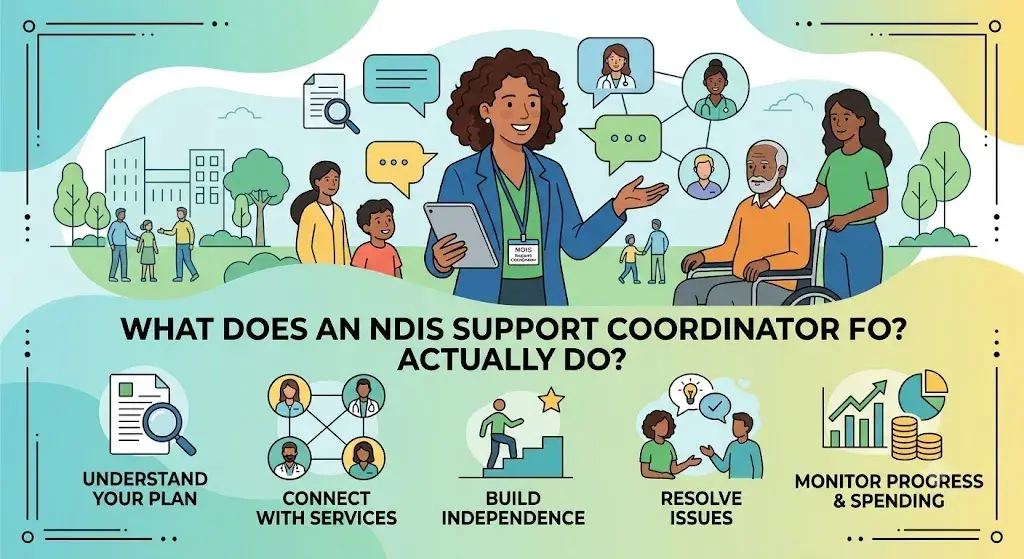
The role of the NDIS Support Coordinator is to help NDIS participants understand their plan, connect to suitable service providers and coordinate their support. The role of the Support Coordinator varies from participant to participant as per the specific needs and situation of the participant and the type of support which the participant needs in their NDIS plan.
For those who are looking for NDIS support coordination services, it is very useful to know the benefits of having the Support Coordinator so that they do not find the NDIS program a cumbersome procedure. The Support Coordinator will help the participant with selection of providers, scheduling of services, dealing with difficulties related to support and any change needed in the situation of the participant.
This guide covers NDIS Support Coordinator, types of support coordination, difference between the roles of the Support Coordinator and Plan Manager or Local Area Coordinator, cost of support coordination and what should be kept in mind while selecting a provider.
What Does an NDIS Support Coordinator Do?
In simple terms, an NDIS Support Coordinator helps you make practical use of the supports in your NDIS plan.
According to the NDIS, a Support Coordinator can help participants understand their plan, choose providers, connect with community and mainstream services, and develop the skills and confidence to manage their own supports.
The exact role can vary depending on your goals, needs, circumstances and the funding included in your plan.
For example, a Support Coordinator may help you:
- Understand your NDIS plan and available supports
- Identify and connect with suitable service providers
- Coordinate different services
- Connect with community and mainstream services
- Understand service agreements and provider arrangements
- Review whether your current supports are working for you
- Find alternative providers when required
- Prepare for changes or challenges in your support arrangements
- Build your skills and confidence to manage your supports
The aim is not to make decisions for you. Rather, a Support Coordinator can provide information and assistance so you can make informed choices about your support.
What Does an NDIS Support Coordinator Actually Do for Participants?
The NDIS Support Coordinator role can involve different tasks depending on the participant. Here are some common areas where support coordination may be useful.
1. Help You Understand Your NDIS Plan
NDIS plans can include different budgets, support and funding arrangements. Understanding what your funding can be used for is not always straightforward.
A Support Coordinator can help you understand your supports and how they may fit with your goals. They can also help you understand things such as service agreements, provider arrangements and how your supporters can work together.
2. Connect You With Service Providers
Finding providers can take time, particularly when you need several different services.
A Support Coordinator can help you identify providers that may be suitable for your needs and preferences. This could include disability support providers, allied health professionals, community services or other relevant supports.
The participant remains involved in choosing the providers they want to work with.
3. Coordinate Different Supports
Some participants receive support from several providers. For example, someone may have a support worker, physiotherapist, occupational therapist and community nursing provider.
A Support Coordinator can help these arrangements work together where appropriate and help identify gaps or issues that may affect the delivery of supports.
4. Help Build Independence
Support coordination is not simply about organising services for someone.
The NDIS describes support coordination as helping participants build confidence and skills to manage and coordinate their own supports. This can include learning how to communicate with providers, understand service agreements, use participant portals and make changes when something is not working.
5. Help When Circumstances Change
Your support needs may change over time.
You may need to find a different provider, adjust how a service is delivered or address an issue with an existing support arrangement.
A Support Coordinator can help you understand your options and work through these changes within the scope of their role.
6. Support You Towards Your NDIS Goals
Your NDIS support should relate to your individual circumstances and goals.
A Support Coordinator can help you consider how different supports fit together and connect you with services that may assist you in working towards those goals.
Levels of NDIS Support Coordination Explained
The NDIS currently describes three levels of support coordination that can be included in a participant’s plan, depending on their circumstances.
Level 1: Support Connection
Support Connection focuses on helping participants understand their plan and connect with funded, community and mainstream support.
It can also help participants build confidence in connecting with services and managing their plan.
Level 2: Support Coordination
This is the level most people are referring to when they use the term “support coordination”.
It can involve putting a mix of supports in place and helping participants develop skills to manage service delivery, maintain relationships, live more independently and participate in their community.
Level 3: Specialist Support Coordination
Specialist Support Coordination is intended for participants with more complex situations who require a higher level of support.
The NDIS explains that specialist support coordinators can assist participants to address complex barriers affecting access to support and maintain consistency during challenges in their support environment.
The level of support that may be appropriate depends on the participant’s individual circumstances and what is included in their NDIS plan.
How to Find a Good Support Coordinator
If you are looking for NDIS support coordinators, the right choice will depend on your individual needs and preferences.
Here are some questions you can consider before choosing a provider.
- Ask whether they have experience supporting people with circumstances similar to yours.
- Good communication matters when several people are involved in your support.
- If you live in Adelaide, local knowledge can be useful when identifying providers and community services.
- Depending on where you live, this may include the Northern Suburbs, Western Suburbs, Adelaide CBD or Port Adelaide.
- Before starting, ask what the provider will do, how often you will communicate and how their services are charged.
Do You Feel Comfortable Working With Them?
Support coordination involves ongoing communication, so a comfortable working relationship can be important.
You should have an opportunity to ask questions and decide whether the provider is suitable for your circumstances.
What to Expect From Your First Meeting With a Support Coordinator
Your first meeting is generally an opportunity to understand each other and discuss what you need.
You may talk about:
- Your NDIS plan
- Your goals and priorities
- Your current supports
- Providers you already use
- Any gaps or challenges
- Your communication preferences
- Your family or carer’s involvement
- What you would like help with
What happens next? You do not need to have everything worked out before the meeting.
The NDIS recommends speaking with a Support Coordinator before signing up so you can ask questions and decide whether they are suitable for your needs. Once you choose a provider, a service agreement can help clarify the services being provided, how they will be delivered and the duration of the arrangement.
Finding NDIS Support Services in Adelaide
Getting information on how NDIS support coordination works in Adelaide is one thing but it is as important as having access to reliable nursing and disability support services to suit individual needs.
ABE Nursing and Support Services is an NDIS Registered Service Provider located at Paralowie in South Australia, offering customised nursing and disability support. The company’s staff has over 15 years’ experience as Nurses, offering support to NDIS participants all over South Australia.
ABE follows a client-centered and family inclusive approach, which includes community nursing, home-to-hospital support, support with activities of daily living, community participation and other disability support services.
If you are interested in nursing or disability support, you may get in touch with ABE Nursing and Support Services to understand your needs better.
Frequently Asked Questions
What does an NDIS support coordinator actually do?
An NDIS Support Coordinator can help you understand and use your plan, connect with suitable providers and community services, coordinate supports and build your confidence to manage them. The exact role depends on your individual plan and circumstances.
Do I need a support coordinator on my NDIS plan?
Not necessarily. Whether you need support coordination depends on your circumstances, goals and support needs. If you would like one, you can discuss support coordination as part of your NDIS planning process.
How much does NDIS support coordination cost?
Costs vary according to the level and amount of support provided and the applicable NDIS pricing arrangements. Check the current NDIS pricing information and discuss fees with your chosen provider before commencing services.
How do I find a support coordinator in Adelaide?
You can research providers, ask questions about their experience and services, compare their approach and discuss fees before choosing one. The NDIS also provides guidance on finding a Support Coordinator.
What is the difference between a Support Coordinator and a Plan Manager?
A Support Coordinator helps with organising and coordinating supports, while a Plan Manager primarily manages the financial administration of an NDIS plan, including claims, provider payments and budget tracking.
What should I expect from my first meeting with a Support Coordinator?
You can expect to discuss your plan, goals, current supports, challenges, communication preferences and what you would like assistance with. It is also a good opportunity to ask about the provider’s services, fees and arrangements before making a decision.